

Phones for Kids: What’s Actually Worth Buying in Australia
If you’ve typed “phones for kids” into Google lately, you already know what happens. You get a wall of smartwatch reviews, a few suspiciously cheap Androids, and approximately forty-seven conflicting opinions from people who may or may not have ever met a child.
So let’s actually sort through it.
This is a straight-talking guide to what’s available in Australia right now, what the trade-offs look like in real life, and one option that takes a genuinely different approach to everything else on the market.
What Parents Are Actually Trying to Solve
Before diving into products, it helps to be honest about what the brief really is. Most people searching for phones for kids aren’t after a smartphone. What they actually want is pretty simple: a way to reach their child, a way to know where their child is, and a way to not accidentally hand the entire internet to a nine-year-old.
Three things. Should be easy. It isn’t, because most products manage to miss at least one of them.
The Main Options for Kids Phones in Australia
Smartwatches
This is the biggest category. Brands like Spacetalk, Xplora, and Vodafone Neo all sit here. They offer calling, GPS, and some have basic messaging built in. The wrist-based form factor is genuinely useful because kids are less likely to leave them on the bus. The downsides: fiddly to use, tiny screens, battery life that ranges from fine to genuinely annoying, and a lot of kids find them uncomfortable or daggy once they hit about eight or nine. Many also lock you into carrier-specific plans with limited flexibility.
Budget Smartphones
Some parents go the cheap Android route, parental controls switched on, fingers crossed. It sort of works. Until the day it doesn’t. Parental controls are imperfect, kids are resourceful, and you’ve essentially handed over a device with a camera, a browser, and a door to every app in existence. You’ve also started the smartphone clock earlier than you probably planned to, which tends to be a one-way door.
Screen-Free Kids Phones
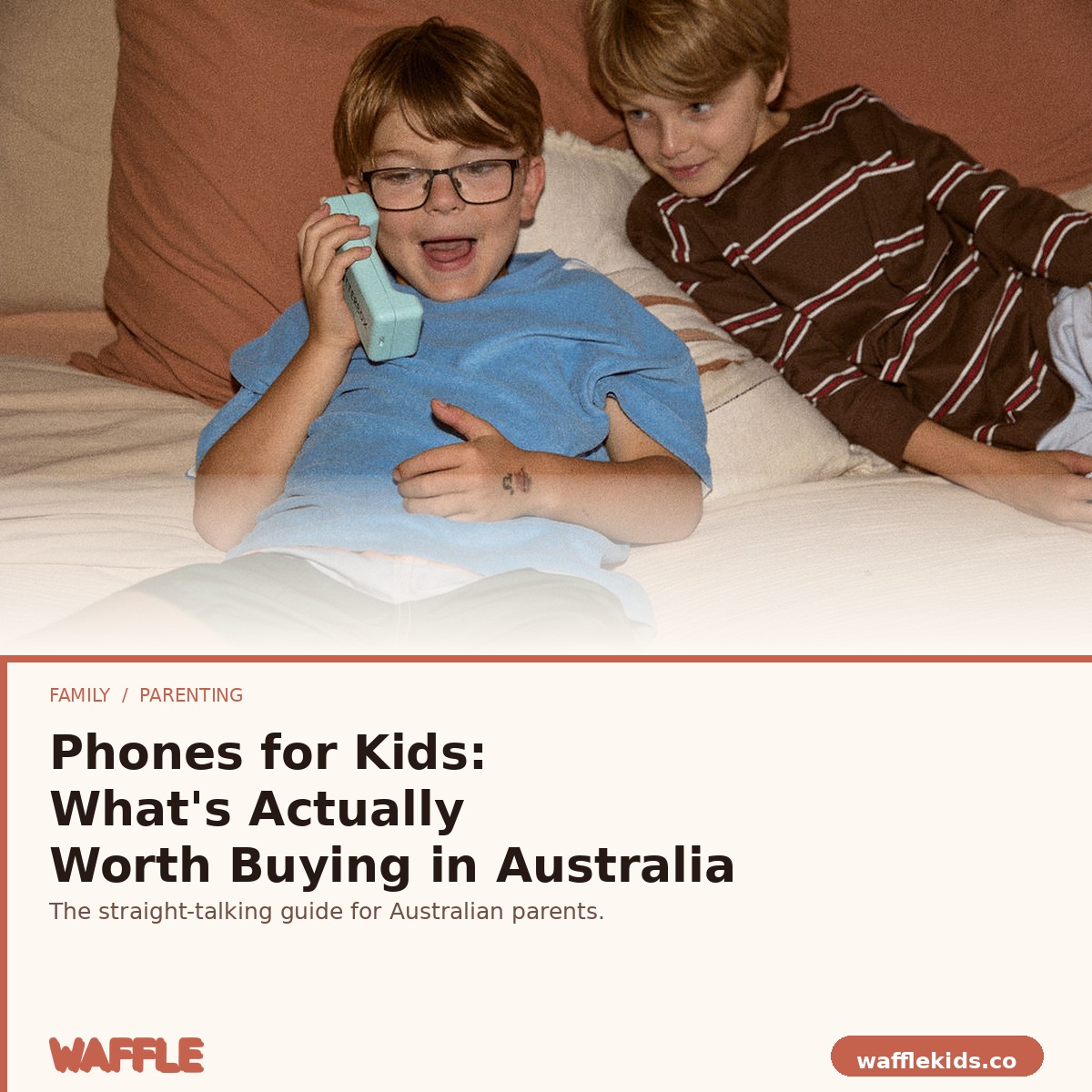
The smallest category, but the most interesting one. The idea is simple: a device that calls and receives calls, has GPS if needed, and does absolutely nothing else. No screen. No apps. No camera. A phone in the original sense of the word, before phones became pocket computers we’re all slightly addicted to.
The standout option in this space right now in Australia is Waffle.
Waffle: The Screen-Free Phone for Kids That’s Doing Something Different
Waffle makes two phones for kids and the philosophy behind both of them is pretty clear: let kids be reachable without giving them a reason to stare at a screen.
The Waffle Go is the portable one. It works anywhere in Australia on its own built-in eSIM, no WiFi needed, no SIM card to sort out separately. It has GPS with Safe Zones, which means you set locations (school, grandma’s, the local park) and get a notification the moment your child arrives. No anxious phone-checking. No sending a follow-up text to see if they got there. Just a quiet notification that tells you what you needed to know.
The Waffle Home is a home device that sits on the kitchen bench and connects over WiFi. It’s basically a modern version of the family landline, the one you used to sprint across the house to answer as a kid. Grandparents can call from their landlines. Parents can call from their mobiles. Kids just answer.
Both devices work on approved contacts only. Your child can call and receive calls from a list you control through the parent app. No unknown numbers turning up, no one getting through who shouldn’t.
And there is no screen. No apps. No camera. Nothing to scroll, nothing to negotiate over, nothing eating up the hour before dinner.
Who Actually Makes Sense for This?
Waffle is built for the primary school years, roughly five to twelve, when kids are starting to move through the world a bit more independently but aren’t ready for a smartphone and the responsibility that comes with it.
It’s genuinely useful for families where kids move between two households and need to be reachable from both. It works well when grandparents are in the picture and prefer calling to messaging. And it suits any parent who wants their child to experience picking up the phone and having a real conversation, without everything else a screen brings with it.
It’s not trying to be a smartphone. It knows it’s not a smartphone. And for a specific window of childhood, that’s exactly the point.
Pre-Orders Are Open Now
Waffle is available to pre-order in Australia with shipping from October 2026. Full payment is due 30 June 2026, so the window is close. Head to wafflekids.co if you want to get in before the cutoff.
So Which Phone for Kids Is Actually Right for Yours?
Honestly, it depends on the age, the situation, and what problem you’re trying to solve.
For younger kids who need GPS and calling in a wearable form, a smartwatch is a reasonable starting point. For primary schoolers gaining independence who don’t need a full device, a screen-free phone for kids like Waffle fills the gap better than anything else currently available in Australia. For high schoolers who genuinely need a smartphone for school and social life, a budget device with parental controls set early is probably the practical call.
The thing worth remembering is that this doesn’t have to be a permanent decision. The right device at seven is rarely the right device at thirteen. Start with the least powerful thing that solves the actual problem, and upgrade when there’s a genuine reason to, not just because it’s easier than the conversation.
Have you been through this with your kids? Drop a comment below, always good to hear what actually worked for people.